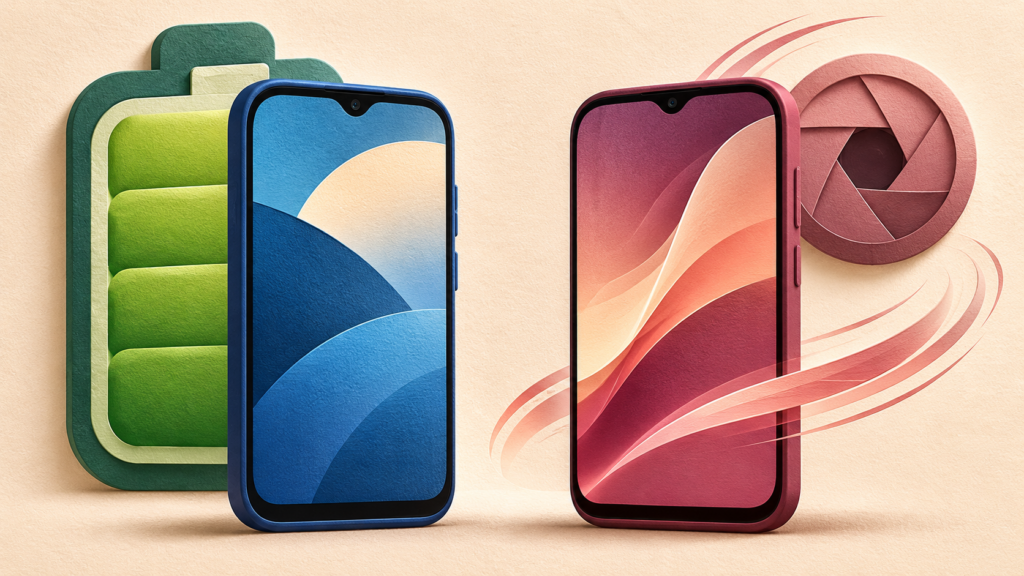
Karbonn has officially returned to India’s smartphone market with two budget Android phones, the Rebel and Rebel Pro. Both were unveiled on November 2, with sales scheduled to begin on Amazon on November 4. The important detail for anyone considering an early purchase is that these are 4G phones, not 5G models.
The regular Rebel is launching at ₹11,999, while the Rebel Pro costs ₹12,499. Karbonn is advertising effective prices of ₹10,999 and ₹11,499 respectively after a ₹1,000 bank offer. That distinction matters: the lower numbers are not the normal purchase prices and depend on qualifying for the promotion.
The choice between the two is unusually straightforward. The regular Rebel gives you the larger 7,000mAh battery. The Pro sacrifices 1,000mAh of capacity for a faster 120Hz display, a 64-megapixel main camera and slightly faster charging. With only ₹500 separating their launch prices before the bank discount, neither is simply a more expensive version of the other.
Karbonn Rebel vs. Rebel Pro at a glance
| Feature | Karbonn Rebel | Karbonn Rebel Pro |
|---|---|---|
| Launch price | ₹11,999 | ₹12,499 |
| Price with advertised bank offer | ₹10,999 | ₹11,499 |
| Cellular network | 4G | 4G |
| Display | 6.75-inch HD+, up to 90Hz, 650 nits | 6.7-inch HD+, 120Hz, 720 nits |
| Main camera | 50MP | 64MP |
| Battery | 7,000mAh | 6,000mAh |
| Wired charging | 18W | 20W |
| Operating system | Android 16 | Android 16 |
| Dust/splash rating | IP64 | IP64 |
| Expandable storage | Up to 1TB | Up to 1TB |
The hardware details above are based primarily on Karbonn’s own Rebel product page and Rebel Pro product page. The company also says chargers are included in the box with both phones.
The November 4 sale is real, but the ₹10,999 and ₹11,499 prices have a condition
Karbonn announced the phones on November 2 and says the first sale starts November 4 on Amazon. In its launch post for the Rebel Pro, the company advertised a starting price of ₹11,499 including a bank offer and explicitly named November 4 as the sale date. The post is reproduced in full in Digit’s launch coverage.
Without that ₹1,000 bank discount, the launch prices reported for the two phones are ₹11,999 for the Rebel and ₹12,499 for the Rebel Pro. That is the more useful pair of numbers when comparing the phones with alternatives, because not every buyer will necessarily have an eligible card or payment method.
It is also worth treating these as launch prices, rather than assuming they will remain unchanged indefinitely. If you are buying after the initial sale period, check the live Amazon listing rather than relying on the November 2 announcement.
These Rebel phones are 4G, not Karbonn’s upcoming 5G model
This is probably the biggest reason some buyers should wait. The Rebel and Rebel Pro announced on November 2 support 4G rather than 5G. Independent launch specifications published by Gadgets 360 list 4G LTE connectivity for both devices, and 91mobiles likewise identifies both as 4G smartphones.
A Rebel-branded 5G phone has been discussed separately, but that is not either of the two models going on sale November 4. Digit’s launch report says the Rebel 5G launch date will be announced later. There is therefore no confirmed Rebel 5G sale date to compare directly with November 4 yet.
For someone who plans to keep a phone for several years, that distinction is meaningful. 4G remains usable, but buying a new 4G-only handset in late 2026 means giving up 5G from day one. If 5G matters to you, the sensible move is not to assume the Rebel or Rebel Pro will gain it through software; cellular capability is a hardware feature. You would need to wait for Karbonn’s separate 5G model or choose another 5G phone.
The regular Rebel is the battery-first model
Karbonn gives the Rebel a 7,000mAh battery, compared with 6,000mAh in the Pro. Battery capacity alone cannot tell us exactly how many hours either phone will last in real use, and there are no independent endurance tests yet that justify making that claim. But the 1,000mAh difference is substantial enough to make the regular model the more obvious choice for buyers prioritizing capacity over display smoothness or camera resolution.
The trade-off is charging speed. The Rebel supports 18W wired charging. That is modest for such a large battery, so buyers should not mistake the word “fast” in marketing material for the kind of high-wattage charging available on many more expensive Android phones. Karbonn does at least say the charger is included in the box.
The Pro drops to a still-large 6,000mAh battery and increases charging to 20W. The two-watt difference is small, so the Pro should not be chosen primarily because of charging speed. Its more meaningful upgrades are elsewhere.
The Rebel Pro spends its ₹500 premium on the screen and camera
The standard Rebel has a 6.75-inch HD+ display rated at up to 650 nits, while Karbonn’s product materials describe a smooth refresh rate; launch reporting places it at up to 90Hz. The Pro uses a slightly smaller 6.7-inch HD+ panel but increases the refresh rate to 120Hz and advertised brightness to 720 nits.
A 120Hz refresh rate can make scrolling and interface animation look smoother, but the resolution remains HD+. The Pro therefore improves motion rather than pixel density. Anyone expecting the “Pro” label to mean a sharper Full HD+ screen should adjust expectations.
The camera difference is similarly easy to understand on paper: the Rebel has a 50-megapixel main camera, while the Rebel Pro gets a 64-megapixel main camera. Karbonn also promotes a 16-megapixel front-facing camera on the Pro in launch specifications reported by multiple outlets.
Megapixel count alone does not establish image quality, however. Until independent camera testing is available, it would be premature to say the Pro takes materially better photos simply because its primary sensor has a higher resolution. What is confirmed is that Karbonn has given it the higher-resolution camera hardware.
Android 16 is a welcome starting point; the update promise needs careful wording
Both phones ship with Android 16. Karbonn also promotes what it calls “pure Android 16” with zero bloatware, along with Google Gemini integration.
The more important long-term detail is the company’s exact support language. On both official product pages, Karbonn says “2 years of security patches” and “2 years of software updates.”
That should not automatically be interpreted as a guarantee of two major Android version upgrades. Some launch coverage has described the policy that way, but Karbonn’s own currently published wording is broader. Until the company explicitly defines how many Android platform upgrades are included, the safest interpretation is simply that it promises two years of software updates and two years of security patches.
That is also worth factoring into the purchase alongside 4G. Someone buying primarily for a low upfront price may find two years adequate. Someone hoping to keep a phone securely updated for four or five years should recognize that Karbonn is currently making a much shorter commitment.
There are still a few specifications worth checking on the actual sale listing
Karbonn’s pages clearly confirm the batteries, charging rates, cameras, displays, Android version, IP64 rating, 3.5mm headphone jack and storage expansion up to 1TB. The regular Rebel page also describes configurations of up to 6GB of RAM and 128GB of storage.
Some third-party launch reports disagree on details such as the exact processor designation and memory configurations, however. Karbonn’s public product pages describe an octa-core processor but do not clearly identify a specific chipset in the same material. Reports have variously named different MediaTek parts.
That makes the retail listing especially important on November 4. Before ordering, verify the exact RAM, built-in storage and processor attached to the specific SKU in your cart rather than assuming every specification repeated elsewhere applies to every version.
There are fewer ambiguities around the practical extras. Karbonn lists IP64 dust and splash resistance, fingerprint and face unlocking, Bluetooth, USB-C and a 3.5mm headphone jack. It also says it has more than 500 service centers across India, a potentially relevant point for a brand re-entering a smartphone market where after-sales support can matter as much as specifications.
Which one makes more sense?
If you already know you want one of these two phones, the standard Rebel is the more distinctive proposition. For ₹11,999 before the bank offer, it gives you the larger 7,000mAh battery while retaining Android 16, expandable storage, IP64 protection, a headphone jack and an included charger.
The Rebel Pro is the better fit if the 120Hz display and 64-megapixel camera matter more than maximum battery capacity. At the announced launch prices, its ₹500 premium is small enough that buyers who value a smoother screen may find it easy to justify. The 20W charging rate, by itself, is not a major reason to upgrade.
The more consequential decision is whether to buy either one at all if you want 5G. These two November 2 launches are 4G devices. Karbonn has a separate 5G Rebel in the pipeline, but there is not yet a confirmed sale date for it. If you can wait and 5G is part of your buying criteria, waiting for that announcement makes more sense than buying a 4G Rebel on November 4 and expecting the connectivity situation to change later.
For buyers comfortable with 4G, the November 4 sale is the date to watch. Just compare the ₹11,999 Rebel and ₹12,499 Rebel Pro prices first, then treat ₹10,999 and ₹11,499 as conditional effective prices if your payment method qualifies for Karbonn’s advertised ₹1,000 bank offer.