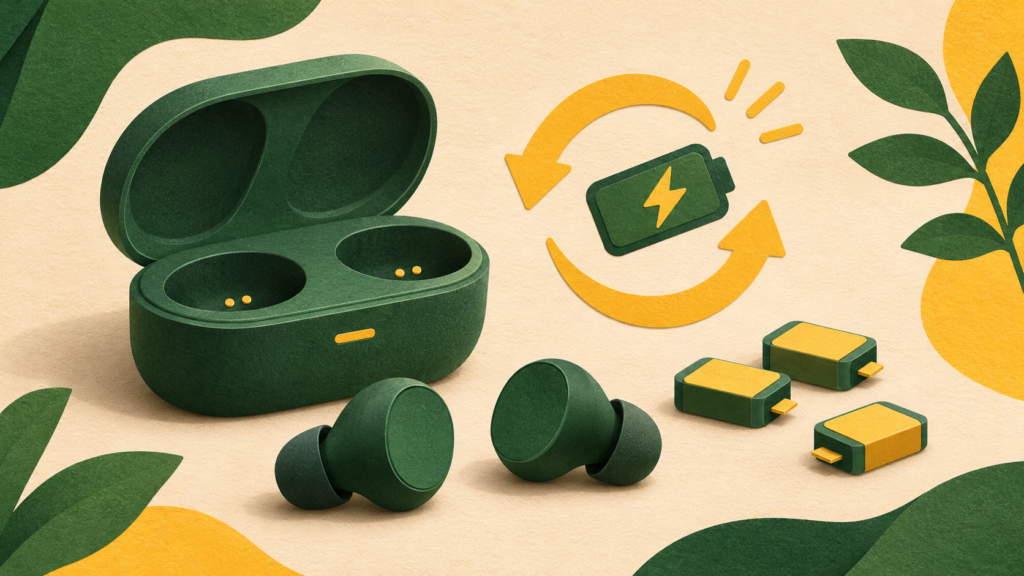
Fairphone’s Fairbuds 2 are now on sale in the United States, offering a way to keep your earbuds when their batteries wear down. US sales began November 2, following the October 14 European introduction. The US store lists them at $119.99 in Horizon Black or Forest Green.
The practical attraction is being able to replace the batteries in both earbuds and their charging case while keeping the working hardware. There is an early catch, however: as of November 4, the US store has prices for those replacement batteries, but both listings are marked “Coming soon.” Buyers can get the earbuds now; the inexpensive battery refresh remains something to plan for.
What replacing all three batteries would cost
Fairphone describes the Fairbuds 2 battery changes as tool-free and glue-free. Its launch announcement identifies seven replaceable parts, including the batteries, individual earbuds and case components. That gives a worn battery a different consequence: it can become a small maintenance purchase instead of a reason to replace everything.
The two relevant US parts listings are:
- Earbud batteries: $9.99 for the pair. The Fairbuds 2 Battery Replacement Kit includes two batteries and two silicone rings. You do not need to buy two kits to refresh both earbuds.
- Charging-case battery: $12.99. The separate case-battery listing contains one replacement battery.
At those listed prices, replacing all three batteries would require $22.98 in parts before shipping and tax, about one-fifth of the current $119.99 price for a complete new set. The silicone rings are already included in the earbud kit, so there is no reason to add their separate purchase price to that calculation.
That is a potential maintenance cost, not an order you can complete through Fairphone’s US store today. Both battery pages currently say “Coming soon” and give no shipping date. Future prices and availability also matter: a battery door is useful only if the right replacement can be obtained when needed. Anyone choosing these primarily for long-term serviceability has a concrete reason to watch the US parts listings before buying.
There is no need to replace all three batteries simply because one has become troublesome. If the earbuds still last through your usual listening session but the case needs charging much more often, the case battery is a separate part. If the problem is in the earbuds, the kit lets you keep the existing case. Diagnose the fault first, especially while warranty coverage may apply.
A lost earbud does not have to mean a whole new set
Fairphone also lists a replacement left earbud and a replacement right earbud at $44.99 each. On November 4, Fairphone’s US store marked the left out of stock and the right coming soon. The option could save the surviving earbud and case after a loss, but check availability before relying on a quick replacement.
The case is modular, too. Its $12.99 outer shell is separate from the $39.99 electronic core; both were listed out of stock. A shell is not a complete charging case, and the core’s listed contents are the core and a screw. Check which component failed before ordering a replacement.
Before spending money on a missing earbud, there is a recovery option. Fairphone’s lost-earbud guide describes viewing its last connected location and playing a sound within Bluetooth range. An empty or closed case cannot be tracked electronically. If a replacement earbud is eventually needed, Fairphone instructs owners to put both earbuds in the case and perform a factory reset to pair them together.
Three years of warranty does not mean three years of free batteries
Fairphone says the US three-year warranty applies automatically, with no registration required. Keep the proof of purchase. Its US warranty summary makes an important distinction: Fairbuds 2 receive three years of coverage excluding the batteries, while the batteries receive one year.
The US limited warranty covers qualifying defects in design, materials and workmanship, and explicitly excludes normal deterioration of battery capacity. A manufacturing fault and a battery gradually holding less charge are different situations. The replaceable design gives you a way to deal with ordinary wear; it does not turn that wear into a free warranty repair.
Opening a product for repair does not automatically cancel coverage. The terms distinguish repair itself from damage caused by an improper repair or installation, which can be excluded. Follow the instructions for the exact model. If a new pair develops a fault, contact Fairphone or the retailer that sold it before buying parts: a covered defect should be assessed through the warranty process.
iPhone owners get an app, but not LDAC
You do not need a Fairphone handset to use these earbuds. They connect through standard Bluetooth to iPhone and Android, and the companion app is available on both. The current iPhone app explicitly supports Fairbuds 2, including sound controls, noise-canceling controls and firmware updates.
For someone keeping an older phone, the app requirements deserve attention. Fairphone’s app support guide specifies Android 12 or later, or iOS 18.2 or later. Those are app requirements, not a blanket minimum for basic Bluetooth listening. The earbuds can be used without the app, but access to its equalizer, firmware updates and extra controls depends on a compatible phone.
For Fairbuds 2, the app also provides ANC and transparency intensity adjustments, the charging case’s battery level and a sound to help locate a missing earbud. Those are useful everyday controls to check before buying: being able to connect an old phone does not establish that it can run the current companion software.
LDAC is a separate limitation. Fairphone advertises the codec at up to 990 kbps, but its product footnote limits LDAC support to Android. You need a compatible Android phone; installing the app on an iPhone does not add LDAC. The higher maximum bitrate describes audio transmission, not a measured multiplication of sound quality. It also tells you nothing by itself about comfort or how well voices cut through during a noisy call.
For moving between a work computer and a phone, Fairphone’s pairing guide confirms two simultaneous connections and memory for six devices. The useful scenario is keeping the laptop and phone connected; six saved devices does not mean six active connections. Android users also get Google Fast Pair, while other devices can connect through their Bluetooth menu.
Plan around six hours with noise canceling
Repairability matters over the life of the product. Between charges, the more relevant number for a noisy commute or flight is Fairphone’s claimed up to six hours with ANC on. Its technical specifications list up to eight hours with ANC off.
The advertised 40 hours combines the earbuds with recharges from the case, with ANC switched off. It is not 40 hours of continuous listening, and it is not the ANC-on total. For a long trip with noise cancellation enabled, plan for the earbuds to spend time charging in their case. All of these figures are manufacturer maximums.
There are two other daily-use limits to account for. Charging is through USB-C, with no wireless charging and no cable included. The IP54 dust-and-splash rating applies to the earbuds only. Keep the case dry, and make sure you already have a suitable USB-C cable if you want to avoid an extra purchase.
Check delivery and return rules before opening the box
The US launch does not mean Fairphone delivers directly to every US address. Its shipping policy covers the 48 contiguous states and Washington, DC, excluding Alaska, Hawaii and US territories. Standard delivery currently ranges from $4.99 to $6.99 by state, with applicable taxes additional. Those charges matter when comparing the price of a small spare part with the final cost of receiving it.
There is also a significant limit behind the advertised 14-day return window. Fairphone’s US return policy excludes in-ear audio products from change-of-mind returns after the protective hygiene seal or outer packaging wrap has been broken. Do not treat a direct purchase as a two-week home fit trial. Defect claims follow separate rules; purchases from another retailer follow that retailer’s return policy.
Fairbuds 2 make the strongest case for someone who needs new earbuds and wants to keep them through future battery wear. The replaceable cells, individual earbuds and separate case components provide specific ways to do that. The immediate question is whether you are comfortable buying the complete product while key replacement parts are still unavailable from Fairphone’s US store.
If your existing earbuds still meet your needs, there is little reason to hurry. Waiting for the battery kits to become orderable would make the repair proposition more concrete. For anyone buying now, the meaningful promise is the ability to pay for a worn component later while keeping the parts that still work.