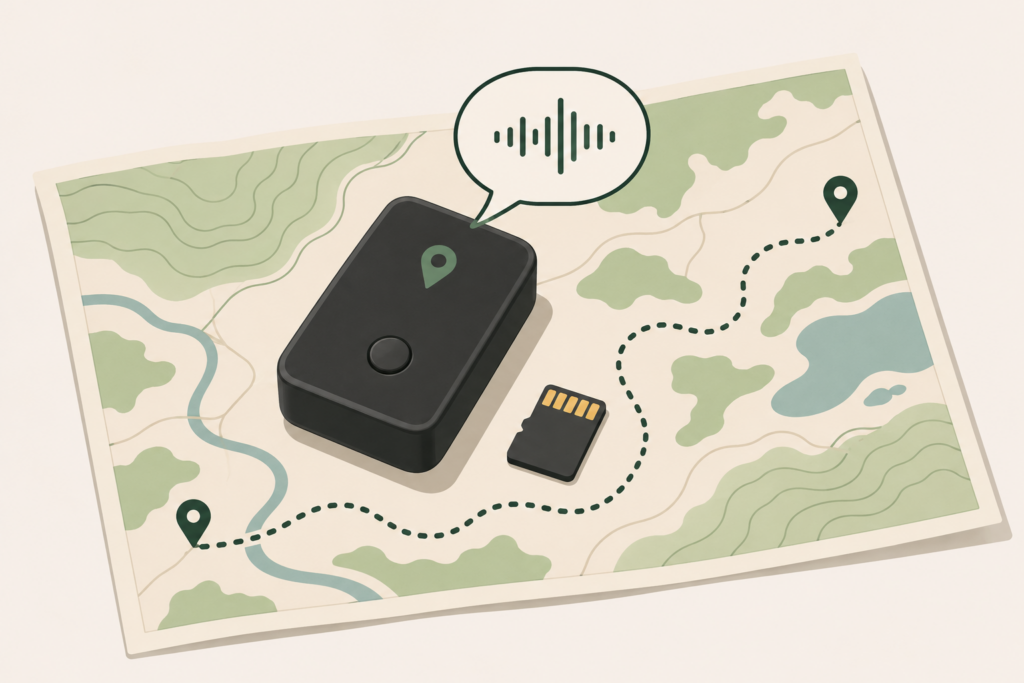
In November 2008 a GPS logger small enough to hang from a key ring did something its rivals did not: it let you speak a note into it. The VisionTac VGPS-900 recorded where you went to a microSD card, and at the press of a button it attached a short voice recording to the spot where you were standing.
Engadget covered the launch on November 11, 2008, crediting Mobile Gadget News, and reported that orders were open at $110. The same hardware had surfaced a few months earlier as the Columbus V-900, at the time without a price or release date.
What the VGPS-900 did
The logger wrote a timestamped track to the card. Bluetooth let it serve as a live GPS receiver for a phone or laptop, which mattered in 2008, when most Windows Mobile handsets still had no GPS of their own. VisionTac presented voice recording as a first among GPS data loggers, and promoted a “spy mode” that stretched standby logging to 30 days.
Photographers were an obvious audience. If you compare the times your pictures were taken with the times in the track, each photo can be given coordinates even though the camera itself had no GPS. Columbus’s Time Album software does that matching on the desktop.
One device, two names
The GPSBabel documentation treats the VisionTac VGPS-900 and the Columbus V-900 as one format and describes them as two brand names for what appears to be the same product. The Columbus name outlived VisionTac’s in GPS: Columbus still publishes V-900 manuals and Time Album Pro for Windows, macOS and Linux. Those downloads target Columbus’s own V-900 revisions, so treat them as a convenience for an original VisionTac unit, not a guarantee.
Reading an old card today
You do not need the original installer disc to recover a trip. The logger stored its records as CSV files on the microSD card and its voice notes as separate WAV files. Copy the whole card with any reader before experimenting.
GPSBabel reads the V-900 format directly. The command gpsbabel -i v900 -f input.csv -o gpx,gpxver=1.1 -F output.gpx turns a log into a GPX file that current mapping and photo tools open. With GPX 1.1 output, each voice waypoint keeps a link to its WAV file, so keep the audio in the same folder as the converted track.
Check the date before you trust the track
GPS satellites broadcast the week number in a counter that rolls over every 1,024 weeks; the most recent rollover came in April 2019. Columbus says that affected V-900 loggers, Mark I units with the MTK3329 chip sold from 2010 to 2015, now write wrong dates, and it offers a firmware update for that group only. Later Mark II units are not affected.
Columbus does not say whether a 2008 VisionTac unit has the same problem. Record a short track outdoors and read the date in the raw CSV before you rely on the logger to geotag new photos. If the year is wrong, the positions may still be usable, but automatic photo matching will fail, because it depends on the times lining up.